What Is a NAICS Code?
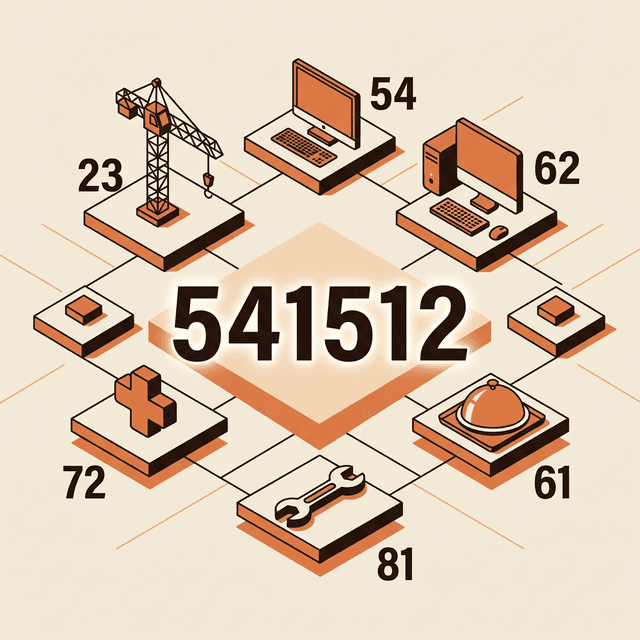
NAICS stands for North American Industry Classification System. It's a standardized six-digit numbering system used by the United States, Canada, and Mexico to classify businesses based on their primary economic activity. Every federal contract opportunity is assigned a NAICS code, and that code determines two critical things for you as a contractor:
- Whether you're eligible to compete — set-aside contracts are restricted to businesses whose NAICS code matches the opportunity
- Whether you qualify as a small business — the SBA's size standard is different for every NAICS code
Getting your NAICS codes right isn't just administrative busywork — it's a strategic decision that directly affects which contracts you can chase and how you're categorized in the federal marketplace.
The Structure of a NAICS Code
NAICS codes are hierarchical. Each digit narrows the classification:
| Digits | Level | Example | Description |
|---|---|---|---|
| 2 digits | Sector | 54 | Professional, Scientific, and Technical Services |
| 3 digits | Subsector | 541 | Professional, Scientific, and Technical Services |
| 4 digits | Industry Group | 5415 | Computer Systems Design and Related Services |
| 5 digits | Industry | 54151 | Computer Systems Design and Related Services |
| 6 digits | National Industry | 541512 | Computer Systems Design Services |
The more digits, the more specific the classification. For government contracting purposes, you always work with the full 6-digit code.
The 20 NAICS Sectors at a Glance
There are 20 top-level sectors, each covering a broad swath of economic activity:
- 11 — Agriculture, Forestry, Fishing and Hunting
- 21 — Mining, Quarrying, and Oil and Gas Extraction
- 22 — Utilities
- 23 — Construction
- 31–33 — Manufacturing
- 42 — Wholesale Trade
- 44–45 — Retail Trade
- 48–49 — Transportation and Warehousing
- 51 — Information
- 52 — Finance and Insurance
- 53 — Real Estate and Rental and Leasing
- 54 — Professional, Scientific, and Technical Services
- 55 — Management of Companies and Enterprises
- 56 — Administrative and Support and Waste Management
- 61 — Educational Services
- 62 — Health Care and Social Assistance
- 71 — Arts, Entertainment, and Recreation
- 72 — Accommodation and Food Services
- 81 — Other Services (except Public Administration)
- 92 — Public Administration
Small Business Size Standards: Why NAICS Codes Matter Financially
The SBA assigns a size standard to every single NAICS code. If your business is at or below that threshold, you qualify as a "small business" for contracts under that code — and you can compete for small business set-aside contracts.
Size standards are expressed either as annual revenue or number of employees, depending on the industry:
- Most service industries: Revenue-based threshold (e.g., $19M annually for IT consulting under 541512, $30M for management consulting under 541611)
- Manufacturing: Employee-based threshold (typically 500 or 1,500 employees depending on the specific code)
- Construction: Typically $45M–$50M in annual receipts
Here's what makes this strategic: if your business is near the size limit for your primary code, you might qualify as small under a different, adjacent code. This is where knowing your options matters.
How to Find Your NAICS Codes
Method 1: The NAICS Association Search Tool
Go to naics.com and search by keyword. Describe what your business does, and the tool will suggest matching codes. This is the fastest starting point.
Method 2: The Census Bureau's NAICS Search
The U.S. Census Bureau maintains the official NAICS manual. You can search by keyword or browse the full hierarchy. This is the authoritative source.
Method 3: Look at What Your Competitors Use
Search for similar businesses in the SAM.gov entity registry. Their registered NAICS codes are public. This is a great cross-reference.
Method 4: Look at Relevant Contracts
Find a contract opportunity on SAM.gov that matches what you do. The listing will display the NAICS code assigned to that work. That's likely a code you should register.
Can You Register Multiple NAICS Codes?
Yes — and you should. SAM.gov allows you to register as many NAICS codes as accurately reflect your business. However, you must designate one as your primary NAICS code. This should be the code that best represents your primary revenue-generating activity or the market you most want to pursue in government contracting.
Having multiple codes registered means you'll appear in more searches when agencies are looking for contractors, and you'll be eligible for more set-aside opportunities.
NAICS Codes Are Updated Every 5 Years
The U.S. Census Bureau revises NAICS codes every five years. The most recent revision was NAICS 2022. Some codes are added, some are reorganized, and some are retired. If you registered several years ago and haven't reviewed your codes recently, it's worth confirming they're still current — especially for technology-related services, which often see changes.
Common Mistakes to Avoid
- Only registering one code: You're leaving opportunities on the table. Register every code that legitimately applies to your services.
- Choosing a code that doesn't match: The contracting officer reviews your registered codes. If the winning bidder's codes don't match the contract's NAICS code, it's a red flag.
- Ignoring the size standard: Before bidding on any set-aside, verify you meet the size standard for that specific code — not just your primary code.
- Not updating after growth: If your business grows past the size standard for a code, update your SAM.gov profile. Misrepresenting your size is a federal compliance violation.
Frequently Used NAICS Codes in Federal Contracting
Some codes appear far more frequently in federal contracting opportunities than others. Here are high-volume categories:
- 541512 — Computer Systems Design Services (IT)
- 541611 — Administrative Management and General Management Consulting
- 541330 — Engineering Services
- 561210 — Facilities Support Services
- 336411 — Aircraft Manufacturing
- 621112 — Offices of Physicians (healthcare staffing)
- 237310 — Highway, Street, and Bridge Construction
- 518210 — Data Processing, Hosting, and Related Services
Using NAICS Codes with AI GovCon
AI GovCon uses your registered NAICS codes to automatically surface relevant contract opportunities from SAM.gov and other sources. The platform scores each opportunity against your profile — so you're not wading through hundreds of irrelevant listings. Get your codes dialed in, and the platform will do the filtering for you.